
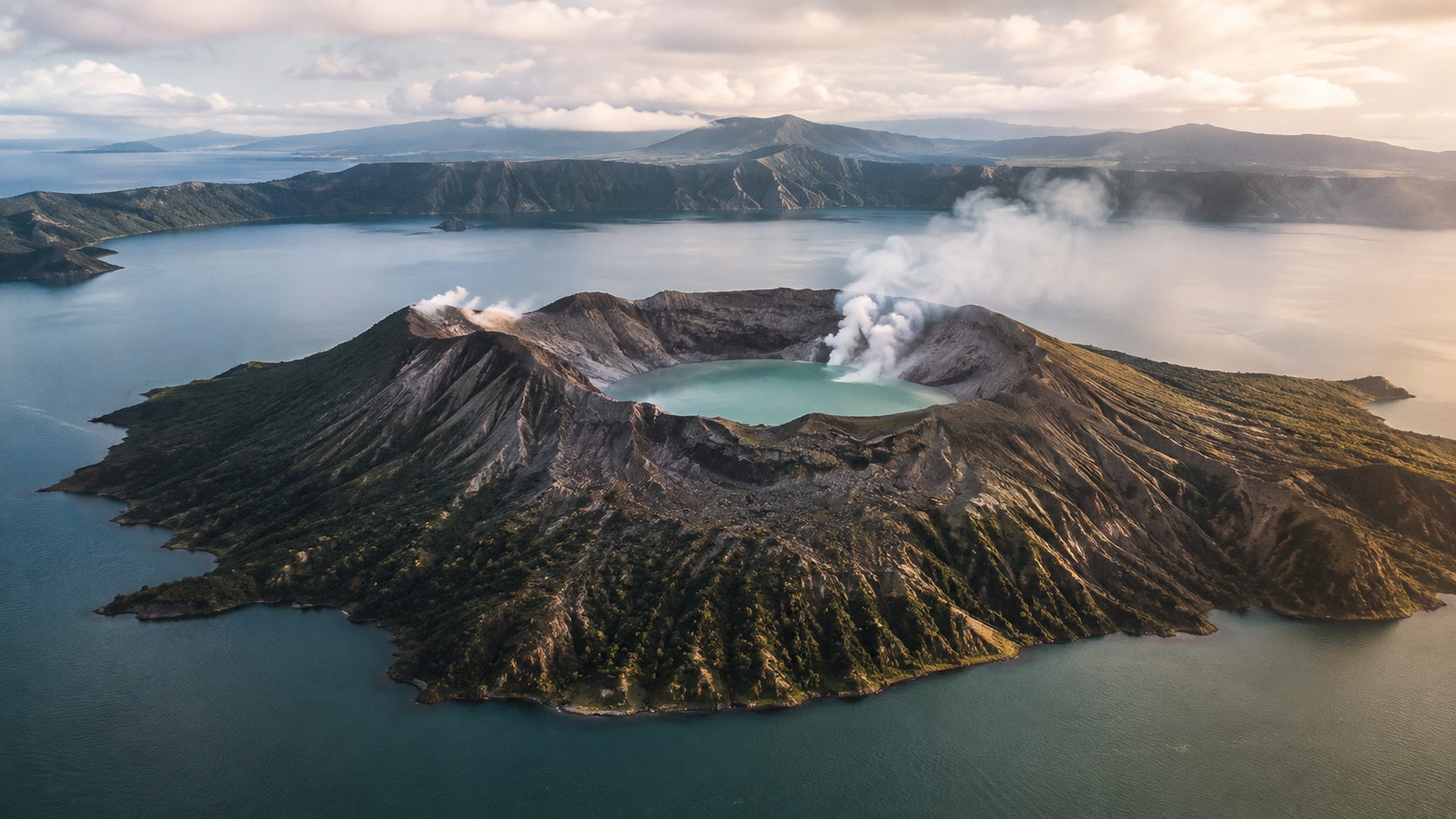
The Philippines is a land sculpted by fire, and nowhere is that more dramatically displayed than at Taal Volcano. Just 50 kilometers south of Manila, this geological oddity features a crater lake nestled within an island that sits inside a larger lake—a hypnotic landscape that has drawn travelers back even after the destructive 2020 eruption.
A Volcano Within a Lake Within a Volcano
Taal’s main crater, located on Volcano Island in the middle of Taal Lake, holds a steaming, sulfurous expanse known as the Main Crater Lake. With a diameter of roughly two kilometers, it is the world’s largest lake on an island in a lake on an island. The water’s color shifts from deep aquamarine to milky jade depending on mineral concentration, rainfall, and volcanic gas emissions. Scientists note that the lake’s temperature can exceed 30°C, and its high acidity—often registering a pH of 2 to 3—creates a hostile environment that nonetheless supports extremophile microorganisms. The vista from the rim, where plumes of vapor rise against the backdrop of the caldera’s forested walls, delivers a raw, almost otherworldly beauty.
The 2026 Trekking Revival and Safety Protocols
After the phreatic explosion of January 2020 forced a long tourism shutdown, Taal roared back into the adventure travel scene in 2026 under strict regulation. The Philippine Institute of Volcanology and Seismology (PHIVOLCS) has maintained Alert Level 1 status for much of the year, indicating low-level unrest but permitting controlled access. According to the official PHIVOLCS Taal Volcano bulletin (https://www.phivolcs.dost.gov.ph/), sulfur dioxide emissions averaged 2,500 tonnes per day in June 2026, well within safe limits for guided treks.
Local operators now limit visitors to 100 per day, require certified guides, and equip every hiker with a gas mask and emergency whistle. The trail, partly restored using volcanic ash, winds past hardened lahar fields and offers interpretive stops explaining the volcano’s violent history. “People want that edge-of-the-world feeling, and Taal delivers it safely now,” said a Batangas tourism officer in a recent briefing. The rebirth of volcano tourism in the region has also spurred the local economy, with lakeside homestays and farm-to-table cafes springing up along the Talisay-Tanauan shoreline.
Crater Colors and Geothermal Wonders
Beyond the main crater, Taal offers lesser-known geothermal treats. The small Binintiang Malaki crater, a parasitic cone, peeks above the lake’s surface like a miniature volcano, while the shores of Volcano Island hide hot springs that locals have used for therapeutic baths for generations. In the early morning, when mist clings to the caldera rim, the entire tableau resembles a classical Chinese ink painting—a scene that savvy Instagrammers chase during the June–August monsoon when cloud formations are most dramatic. The combination of raw power and delicate beauty makes Taal an irreplaceable destination for those seeking the Philippines’ volcanic soul.
About the Author