The Mounting Cost of Discarded Fabric
The Philippines discards approximately 267,111 tonnes of textile waste each year, a figure that has moved from the margins of environmental reporting to the center of the national fashion conversation. A significant share of this waste is not generated by Filipino consumers alone. It includes factory offcuts from garments produced for international brands, unsold imported secondhand clothing, damaged shipments, and overrun inventory—materials that enter the country as part of global production networks and remain after the commercial value has been extracted.
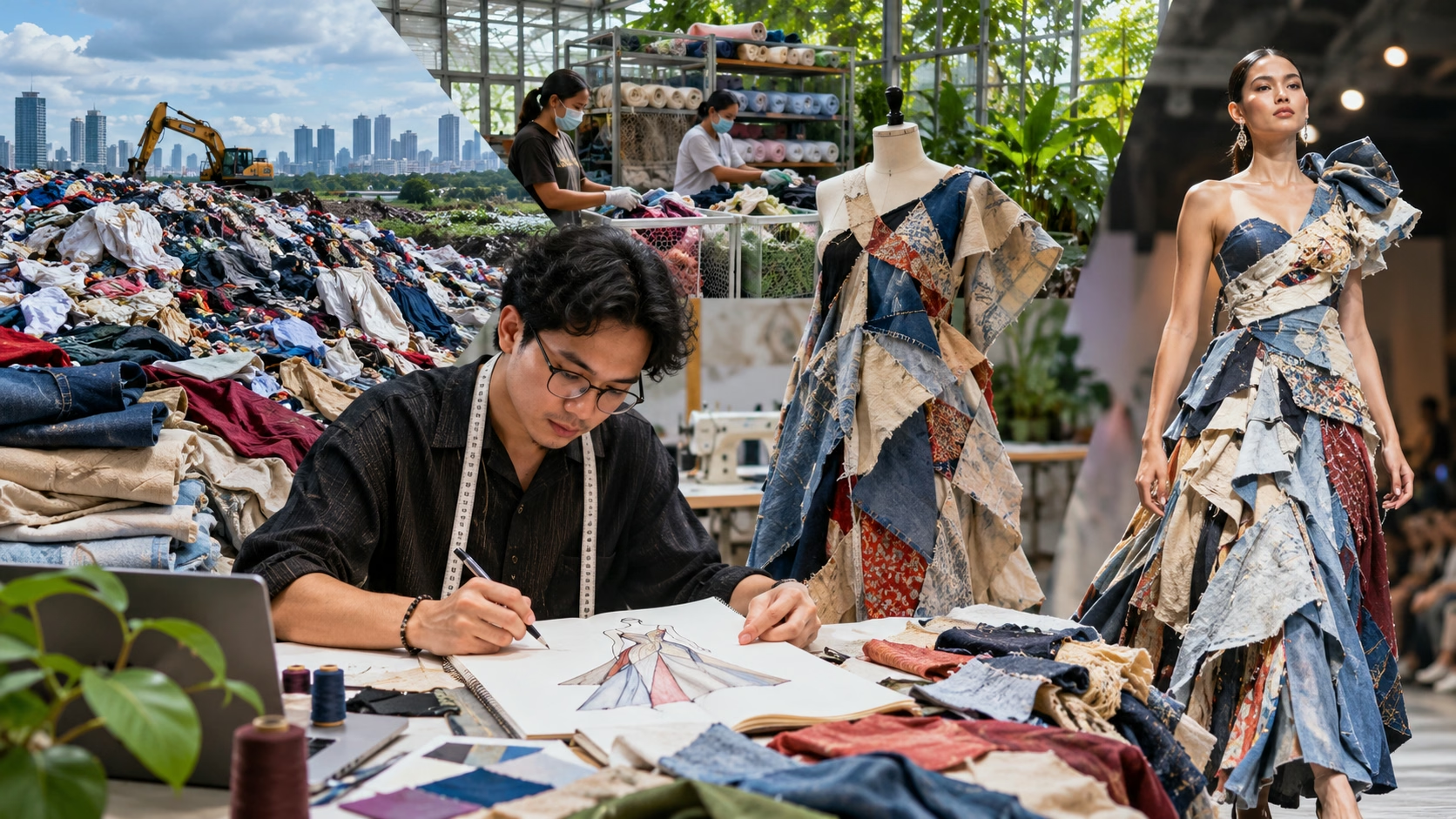
For years, this material flowed almost invisibly toward landfills, informal dumpsites, and scavenger communities. The scale is difficult to visualize: industry estimates suggest the annual volume is equivalent to hundreds of Olympic-sized swimming pools of fabric. The environmental cost is compounded by the loss of embedded resources—water, energy, labor, and raw fiber—that went into producing textiles now treated as refuse.
Circular Design as a Value Proposition
A growing cohort of Filipino designers is reframing deadstock not as a disposal problem but as a design constraint that produces higher-value outcomes. The logic is straightforward: when fabric is scarce, irregular, or available only in limited runs, the designer cannot rely on volume. Instead, value must be created through pattern efficiency, material storytelling, and craftsmanship—the same levers that define luxury fashion.
Cebu-based designer Jann Bungcaras, who brought the Philippine textile waste crisis to the United Nations Fashion and Lifestyle Network panel during Climate Week NYC, operates a label built entirely on discarded textiles. His process begins with three questions: what story needs to be told, what emotion should the garment radiate, and what discarded materials are available. The third question, he argues, is the most important because the brand’s purpose is to create runway and wearable pieces from waste. More than 85 percent of a garment’s environmental impact is locked in the design stage, Bungcaras notes, which means decisions made at the sketch and pattern table determine whether deadstock becomes a high-value product or another failed experiment.
From Landfill-Bound to Runway-Ready
The transformation is not merely symbolic. Deadstock collections require a different production chain. Sourcing is fragmented: designers work with factory surplus, overstock fabric from closing warehouses, and post-industrial remnants that vary in width, color, and fiber composition. Each batch demands separate sampling, shrinkage testing, and pattern adjustment. This fragmentation raises unit costs, but it also creates scarcity that cannot be replicated at scale—a commercial advantage in a market saturated with uniform fast-fashion output.
The resulting garments enter a pricing bracket that competes not on cheapness but on exclusivity and provenance. A deadstock piece carries a documented material history: the factory that produced the surplus, the collection it was originally intended for, and the design intervention that redirected it. For a segment of Filipino and international buyers, that narrative justifies a premium.
The Economics of Upcycled Luxury
The commercial case is strengthening. The Philippine textile recycling market reached USD 25.24 million in 2025 and is projected to reach USD 35.02 million by 2034, growing at a compound annual rate of 3.71 percent. While recycling and upcycling are not identical, the trajectory signals that investors and consumers are beginning to price circular textile activity as an economic sector rather than a niche advocacy.
The remaining challenge is infrastructure. Designers can create high-value collections from deadstock, but without reliable sorting, cleaning, and grading facilities, the material pipeline remains unpredictable. The next phase of growth depends on whether the country can connect its design talent to a formalized deadstock supply chain that treats surplus fabric as a standardized input rather than a sporadic windfall. The designers who have already built collections around this constraint are proving that the value is there; the question is whether the system will catch up.
About the Author