
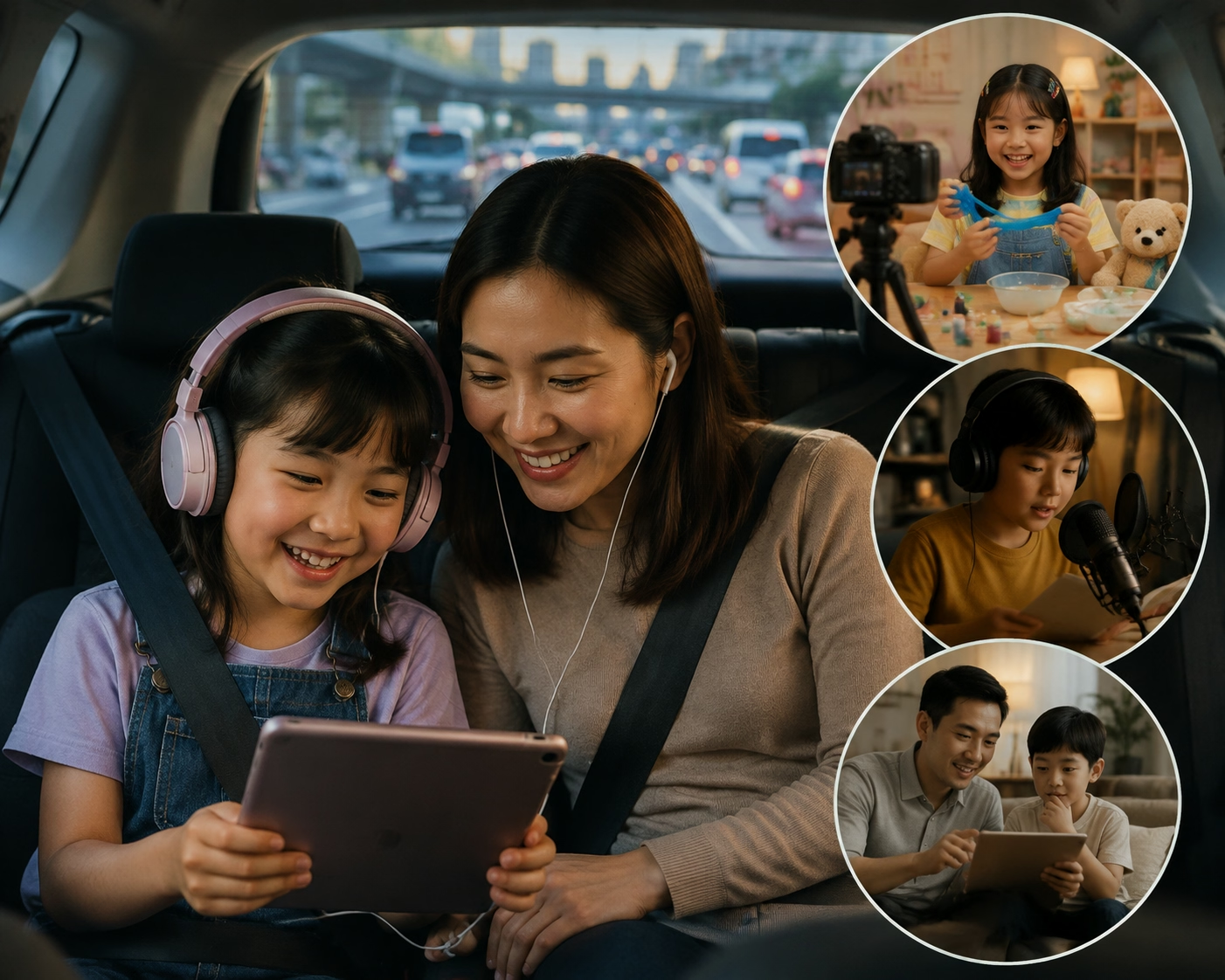
The children’s entertainment industry in the Philippines is undergoing a profound transformation in 2026. The shift in consumption habits from linear television to over-the-top (OTT) and video-on-demand (VOD) services is no longer a trend but a certainty. Filipino children today are digital natives who expect content that is not only entertaining but also interactive and personalized.
Dominance of Local Platforms and Hyper-Localization of Content
One of the most striking developments is the strengthened position of homegrown streaming platforms. While global giants like YouTube Kids and Netflix once ruled the market, local apps offering content in Tagalog and English (Taglish) have successfully captured young audiences. Platforms such as iWantTFC and Vivamax are aggressively expanding their children’s libraries by producing original animated series that highlight Filipino mythology and folklore, such as the tales of Ibong Adarna and Si Malakas at si Maganda, packaged in modern 3D visuals.
This demand for local-language content is fueled by parents who want to instill cultural values early on amid the flood of foreign media. Recent data indicates that local animated film production has jumped nearly 40% compared to the previous year, signaling a thriving creative industry.
Integration of Interactive Technology and AI
2026 marks a new era where content is no longer one-way. Various children’s programs in the Philippines are adopting augmented reality (AR) and artificial intelligence (AI) that allow kids to interact directly with their favorite characters. For example, several educational shows now offer features where children can answer on-screen quizzes using a remote or tablet, and the story adapts based on their answers.
Moreover, the widespread use of AI for real-time dubbing and translation enables children in rural areas to access high-quality content previously available only in foreign languages, thereby narrowing the educational gap.
Education as Entertainment (Edutainment)
Modern Filipino parents, especially in urban hubs like Metro Manila and Cebu, are becoming more selective. They are no longer satisfied with merely “safe” viewing; they demand added cognitive value. Programs such as MathDali on Knowledge Channel have become primetime viewing for young families.
According to a report from the National Council for Children’s Television (NCCT) in the first quarter of 2026, there has been a significant increase in production budgets for programs that teach STEM (Science, Technology, Engineering, and Mathematics) as well as emotional intelligence. This proves that the children’s entertainment market in the Philippines is moving toward a more responsible and sustainable direction.
About the Author