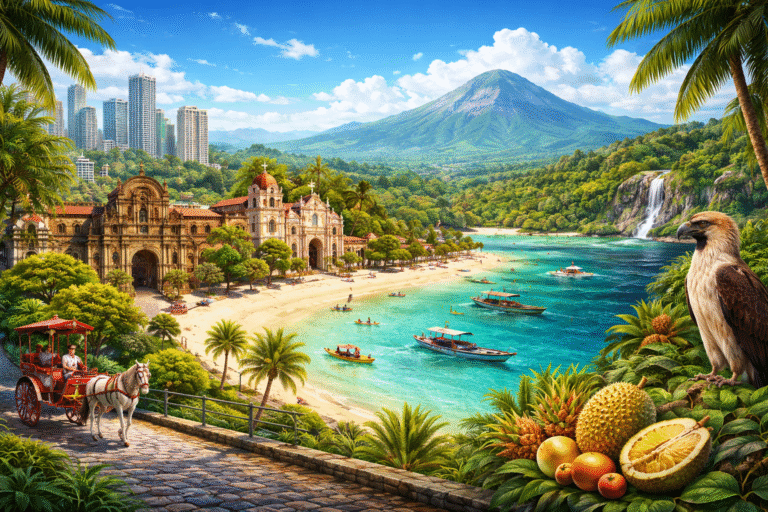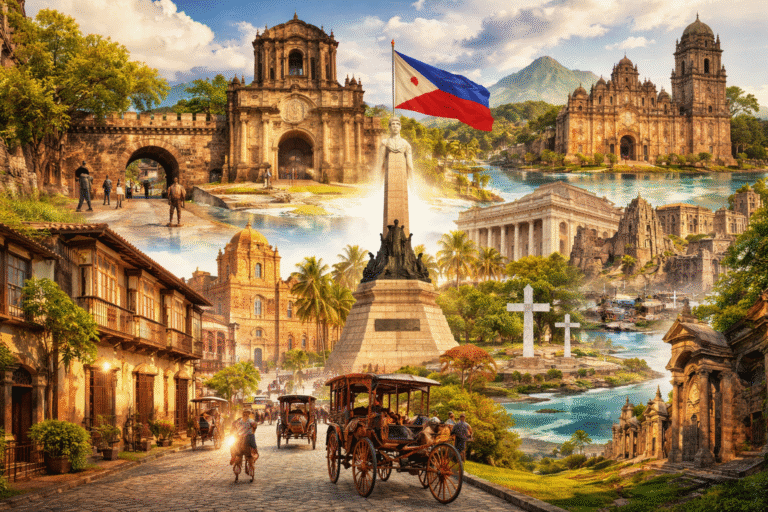

The Philippines is one of Southeast Asia’s most compelling destinations for historical tourism because its cities, churches, forts, and old districts preserve the marks of several colonial eras. For more than three centuries, Spanish authority shaped the country’s religion, architecture, administration, and urban planning. After Spain, the American period introduced new civic institutions, schools, and public infrastructure, while traces of Japanese occupation during the Second World War remain embedded in memorials and battle sites. For travelers interested in the past, the Philippines offers more than scenic beaches; it presents a layered historical landscape where colonial influence and local resilience can be studied side by side.
One of the most important heritage sites in the country is Intramuros in Manila. Often called the “Walled City,” Intramuros was established during Spanish rule as the political and religious center of colonial power. Massive stone walls, gates, and bastions were designed to protect the settlement from foreign invasion and internal unrest. Inside the district, visitors can explore Fort Santiago, a citadel closely associated with military defense and the imprisonment of national hero José Rizal before his execution in 1896. Walking through its grounds gives tourists a vivid understanding of how colonial governments maintained order and how resistance eventually emerged from within that same structure of control.
Religious architecture is another major dimension of historical tourism in the Philippines. Spanish missionaries built churches not only as places of worship but also as symbols of political authority and instruments of cultural transformation. San Agustin Church in Manila, one of the oldest stone churches in the country, stands as a remarkable example of Baroque architecture adapted to local conditions. Across the archipelago, churches in places such as Paoay, Miagao, and Santa Maria demonstrate how European design merged with Filipino craftsmanship, local materials, and responses to earthquakes. These churches are not merely relics of the past; they reveal how colonial religion became deeply woven into Filipino social life.
Outside Manila, cities like Vigan in Ilocos Sur provide a broader picture of colonial urban life. Vigan is renowned for its preserved cobblestone streets, ancestral houses, and hybrid architecture that blends Spanish, Chinese, and indigenous influences. Unlike monumental churches and forts, Vigan shows how ordinary life may have looked during the colonial period. Homes with sliding capiz windows, hardwood interiors, and brick façades reflect the economic position of local elites who navigated trade networks and colonial administration. Historical tourism in Vigan allows visitors to understand not only political domination but also daily customs, commerce, and domestic life.
The American colonial period also left a visible impact. In Manila, Rizal Park, government buildings, and civic layouts reflect American ideas of public space and modern administration. The Americans invested heavily in education, transportation, and public health, presenting their occupation as a civilizing mission while also consolidating control. Historical travelers can trace this era in neoclassical buildings, old universities, and provincial capitols. These places reveal how colonialism changed from ecclesiastical and military domination under Spain to bureaucratic and institutional influence under the United States.
War memory forms another important chapter. Sites linked to the Battle of Manila, Corregidor Island, and memorial cemeteries preserve the trauma of the Second World War. Corregidor, in particular, helps visitors understand the strategic role of the Philippines in the Pacific theater and the immense human cost of occupation and liberation. These places deepen historical tourism by showing that the nation’s past is not only colonial but also shaped by resistance, sacrifice, and reconstruction.
To travel historically in the Philippines is to encounter a nation formed by conquest yet defined by survival. Its heritage sites show how foreign powers altered the islands, but they also reveal how Filipinos absorbed, challenged, and transformed those influences into a culture that remains distinctly their own.
About the Author