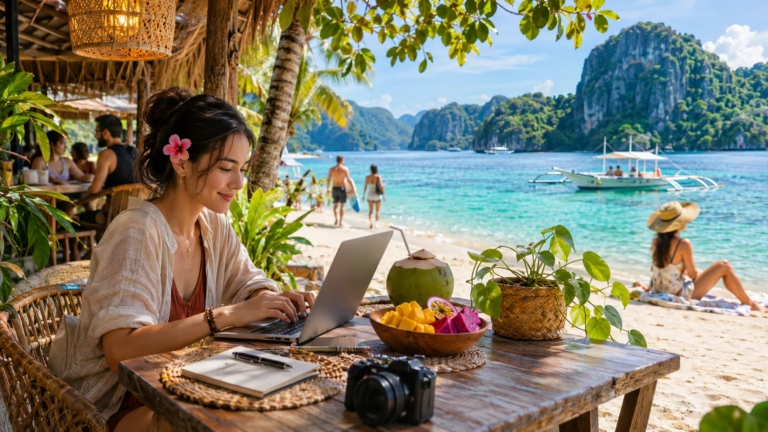

The pitch is intoxicating: trade your gray cubicle for white sand beaches, palm trees swaying outside your co-working space, and a cost of living that lets you live like royalty on a freelancer’s budget. The Philippines, an archipelago of over 7,000 islands, has been quietly positioning itself as the next great frontier for remote workers. With English widely spoken and a brand-new visa framework, the appeal is undeniable. But a successful workation requires more than just a pretty backdrop; it demands a clear-eyed look at the infrastructure and regulations that will actually shape your daily life.
The Legal Gateway: Understanding Executive Order No. 86
For years, digital nomads in the Philippines flew under the radar, endlessly renewing tourist visas. That changed in April 2025, when President Ferdinand Marcos Jr. signed Executive Order No. 86, officially creating the Digital Nomad Visa (DNV) . The visa allows remote professionals to stay for up to a year, with the possibility of a one-year renewal. Crucially, it is designed for those whose employers or clients are based outside the country.
However, the implementation comes with specific caveats. As of early 2026, the Department of Foreign Affairs is still finalizing the full guidelines and the list of qualifying countries based on the principle of reciprocity . This means citizens from countries that do not offer a similar privilege to Filipinos may find the DNV route closed. For those who do qualify, the benchmark for income is often cited around $24,000 annually, alongside requirements for health insurance and a clean criminal record . The key takeaway for the prospective workationer is that while the legal pathway is clearer than ever, verifying your eligibility with the nearest Philippine embassy before booking a one-way flight is non-negotiable.
The Connectivity Conundrum: Beyond the Hype
A workation lives or dies by the strength of its internet connection. Here, the Philippines presents a nuanced picture that requires careful navigation. According to network intelligence firm Ookla, the country’s urban centers are not leading the region in mobile speeds. In the second quarter of 2026, Cebu recorded a median mobile download speed of just 55.48 Mbps, placing it at the bottom of a list of 13 popular Southeast Asian nomad destinations. Manila fared slightly better at 75.57 Mbps but still ranked 10th, trailing far behind Da Nang’s 215.56 Mbps .
The practical implication is that relying solely on mobile data for critical video calls is a gamble. Successful remote workers in the Philippines learn to treat connectivity as a multi-layered system. A reliable fixed-line broadband connection at your accommodation is essential, supplemented by a local 5G SIM card as a backup. Co-working spaces in Metro Manila and Cebu have proliferated to meet this demand, offering business-grade internet and generator backup. For those venturing to more remote islands like Siargao or Bohol, the advice remains: verify the internet situation with your host before booking, and always have a backup plan for the inevitable brownout or slowdown .
The Financial Equation: Living Well for Less
The financial argument for the Philippines remains compelling, provided you adopt local habits. A mid-range lifestyle, including a furnished apartment, utilities, and dining out, can be comfortably managed for around $1,400 per month in many areas, though Metro Manila’s prime districts like BGC or Makati will push that figure higher . In provincial cities like Davao or Dumaguete, a monthly budget of $800 to $1,000 is not unrealistic.
The key to unlocking these savings is integration. A meal at a local carinderia (canteen) costs a fraction of a Western-style restaurant, and using jeepneys or tricycles instead of ride-hailing apps slashes transport costs. However, the “expat trap” is real; frequenting tourist-centric establishments in places like Boracay or Alona Beach will quickly erode the cost-of-living advantage. The most satisfied remote workers are those who treat the Philippines not as a perpetual vacation, but as a temporary home where they shop at local markets, cook their own meals, and integrate into the community rhythm.
About the Author